Heimatlos — Jewish Museum Vienna ·
Can I Find Refuge in Culture? Arthur Hellmer and Theater in Exile
How a theater director driven from Vienna used the stage in exile to preserve language, dignity, and community — an essay on culture as an act of resilience and resistance, written for the catalogue Heimatlos: Wiener Juden im Exil (Jewish Museum Vienna).
Like many Viennese, Arthur Hellmer (born Arthur Ehrlich¹) was born elsewhere: in 1880 in Thomasdorf in Austrian Silesia (today Domašov, Czech Republic). A year later, the family moved to Vienna,² the capital of the Austro-Hungarian empire, where he developed his passion for theater. This path took him to Germany, first as an actor and then theater director. In 1910/11, he founded the Neues Theater in Frankfurt am Main and in 1920 became the sole owner.³ Among other theaters, Arthur also managed the Lessing Theater, the Kleines Theater, and the Trianon-Theater in Berlin.⁴ With the rise of the National Socialists in Germany in 1933 and the passing of the Nuremberg Laws in 1935, Arthur was forced to sell the Neues Theater and fled to Vienna, where he became the director of the Theater an der Wien in 1936. On March 9, 1938, Arthur announced the theater’s upcoming season.⁵ Three days later came the “Anschluss” and he was stripped of his post. In an act of humiliation, Arthur was forced to clean by hand piles of shoes heaped in front of the theater.⁶
After a brief imprisonment, he and his wife Marie (née Breitenfeld, 1885–1965) fled to the United Kingdom as refugees, where he fought to keep German-language theater culture alive, particularly with “Die Österreichische Bühne” (The Austrian Theatre) in 1942, which performed at Stern Hall of the West London Synagogue.⁷ Arthur returned to Germany in 1946, where he was appointed by the Allies to lead the Deutsches Schauspielhaus in Hamburg. Although backed by the Social Democratic Party and Mayor Max Brauer (1887–1973), Arthur encountered a hostile environment at the theater, still plagued by Nazi sympathizers. The ensemble and board emphasized that Arthur, as a Jewish-Austrian returning from exile, was unwanted. The political and cultural outcry surrounding Arthur’s appointment highlights the sad reality of postwar Europe: Jewish exiles were not welcomed back. Arthur ultimately stepped down in 1948⁸ and died in Hamburg in 1961.
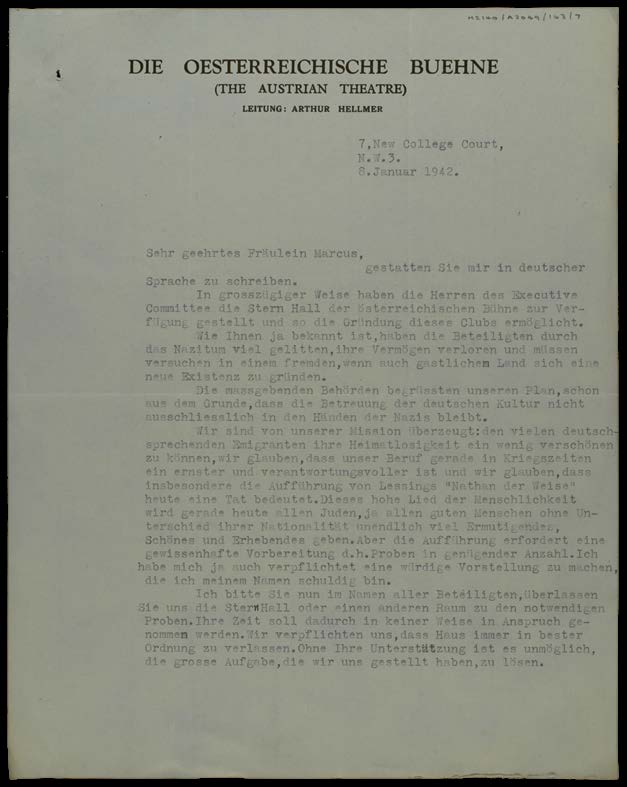
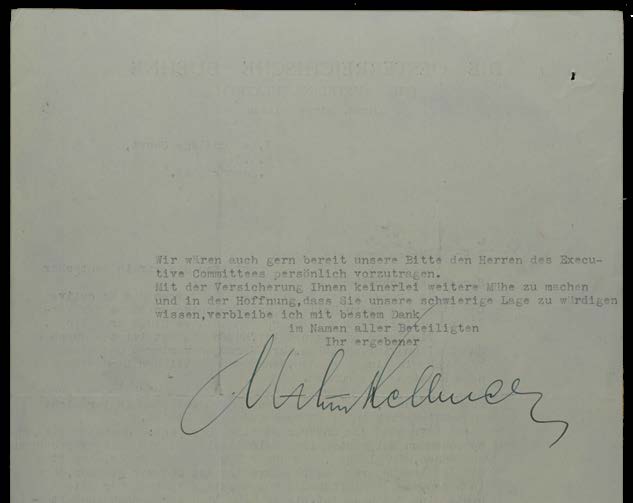
Theater was more than entertainment for émigrés in wartime London or anywhere in the world: it was an act of cultural preservation and resilience. A letter from Arthur, dated January 1942 addressed to the administrators of Stern Hall, shows how refugees who had lost everything to Nazism sought to rebuild community and meaning through art. The choice to stage Lessing’s Nathan the Wise—a play about religious tolerance and humanism—in the middle of the war and in German was deeply intentional. Language was a vital part of theater artists’ identities. Creating opportunities to perform in their mother tongue while in exile was pivotal for self-preservation in times of uncertainty.⁹ Arthur writes, “We are convinced of our mission. We believe that our profession gains all the more importance in times of war in order to provide German-speaking emigrants a bit of relief from being uprooted from their homeland.”¹⁰ Arthur’s life in exile wasn’t just about survival, but also about holding onto identity and values in the face of persecution.
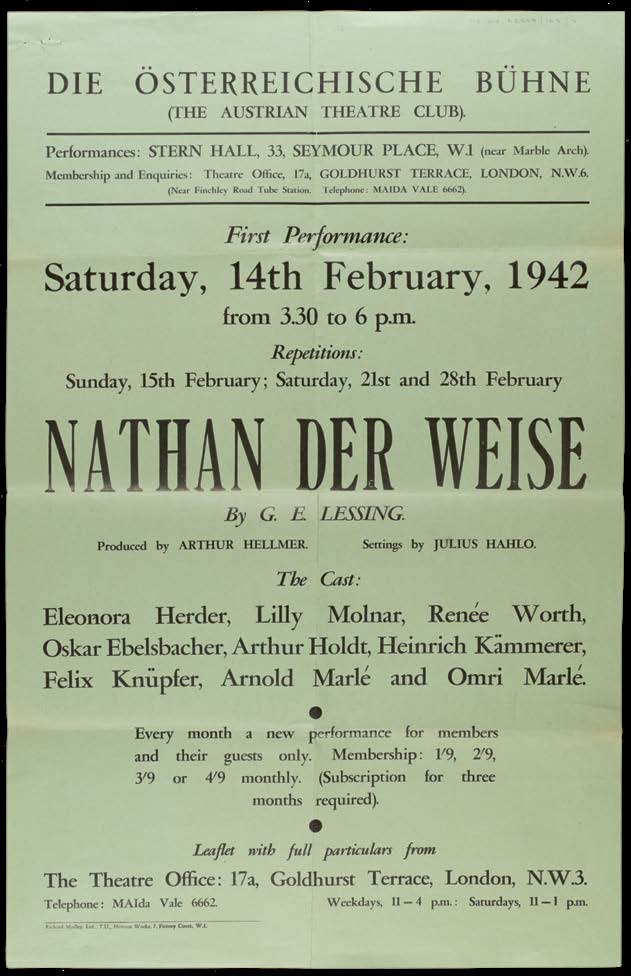
This reflects a broader truth: exile meant losing home, success, and stability—yet it also meant carrying identity forward through action and art. For Arthur, theater was both survival and resistance. The poster from the premiere of Nathan the Wise at The Austrian Theatre, shows that even displaced and without his theaters, there was agency, dignity, and a commitment to bring people together through art, and that the stage was ultimately anywhere Arthur’s journey carried him.
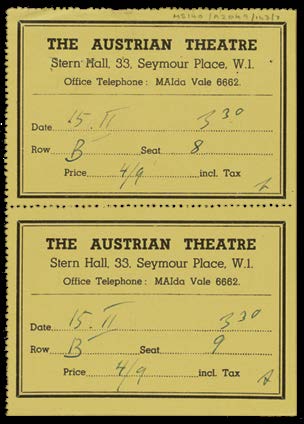
While I can’t begin to fully grasp the anxiety and uncertainty that my great-great-grandfather lived through, Arthur’s perseverance in the face of extreme adversity is deeply inspiring and resonates with me on a profound level. I’m especially moved by his belief that his work was not merely a profession, but a responsibility—to offer encouragement, beauty, and a sense of hope during dark and uncertain times. And, while these items—a letter, a poster, two ticket stubs—might seem modest, they represent an entire world that refugees built for themselves in exile. They are fragments of stories layered beneath the surface, pieces of larger narratives that often emerge from unexpected places. I feel an incredible obligation to keep looking to further understand this all and to reconstruct his life and timeline.
These objects point to the resilience of Arthur Hellmer and those involved in groups like “Die Österreichische Bühne” (The Austrian Theatre), “Freier Deutscher Kulturbund” (Free German League of Culture), and “Club 1943”, illuminating a larger history of cultural resistance that my family was a part of. For me, they are not just artifacts of the past, but reminders of a cultural, artistic, and political legacy I carry forward—and a responsibility to ensure these stories continue to be seen and remembered.
Notes
- Arthur Ehrlich legally changed his name to “Arthur Hellmer” on June 26, 1920. Marriage Record Arthur Hellmer, IKG Archiv, TB_IKG-WienII_1909_58_HELLMER_(EHRLICH)-Arthur.
- Frithjof Trapp/Werner Mittenzwei/Henning Rischbieter/Hansjörg Schneider (eds.), Handbuch des Deutschsprachigen Exiltheaters 1933–1945. Biographisches Lexikon der Theaterkünstler Teil 1 A–K (Band 2), München 1999, 400.
- Ibid.
- Ibid.
- Die Zukunft des Theaters an der Wien. Pachtvertrag mit Hellmer erneuert, in: Das Echo, 9.3.1938, 5.
- Trapp et al., 400.
- Korrespondenz der Österreichischen Bühne, 1941–1942, Archiv der West London Synagogue of British Jews, University of Southampton, Special Collections, MS140/A2049/163/7.
- Trapp et al., 400; Korrespondenz Brendan Ciecko – Caitlin Gura, January 9, 2026.
- For more on language in exile, see Caitlin Gura’s article “Can I Master a New Language? Kurt Klagsbrunn’s Portuguese Notebook” in this catalogue, 107.
- Letter from Arthur Hellmer to Fräulein Marcus, January 8, 1942, Austrian Theatre Club, 1941–1942, Correspondence, in the Archives of the West London Synagogue of British Jews, University of Southampton Special Collections, MS140/A2049/163/7.